This week, Snowbird turned two.
Two years ago when friends, colleagues and acquaintances found out that I wasn’t going to pursue a “job” after a decade at Google, their questions followed a pattern that surprised me then.
It was either “Are you raising?” “Will you build on Google AI or something else?” OR “Will you run workshops?” “Are you getting your coaching certification?”
After Big Tech, apparently the choice is binary: I should have either built an "AI-powered" startup or become a career coach. There is nothing wrong, or easy, about either of those choices. I was doing neither of those things but those questions were interesting because they showed me how ambition is conceived in our collective psyche.
The biggest insight I have arrived at after these two years is that business is people. Everything I am about to tell you applies to individuals as much as it applies to companies.
CONTAINERIZATION OF AMBITION
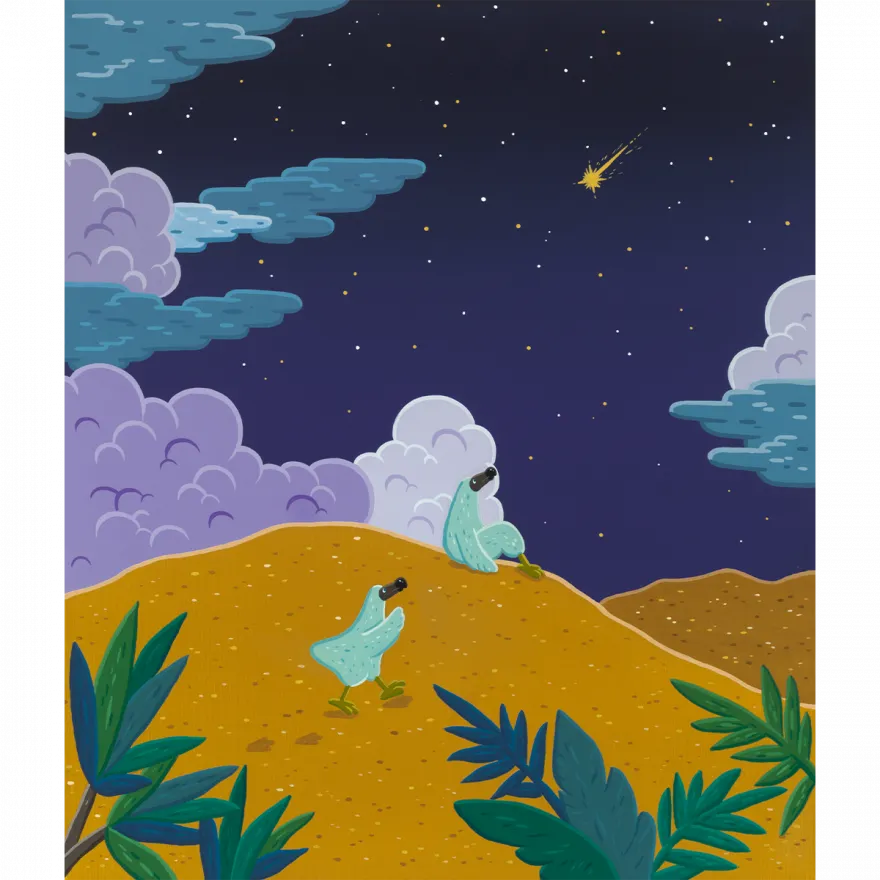
One of the most interesting artists I discovered at the recent Singapore Art Week is Kim Sun Woo from South Korea. Kim exclusively paints Dodos. The dodo, in Kim’s view, got too complacent. It was so comfortable in Mauritius that it lost the ability to fly. It’s Kim’s commentary on the modern human who lives in a culture where rules and strata are so codified that they never feel the need to question it, let alone step out of it.
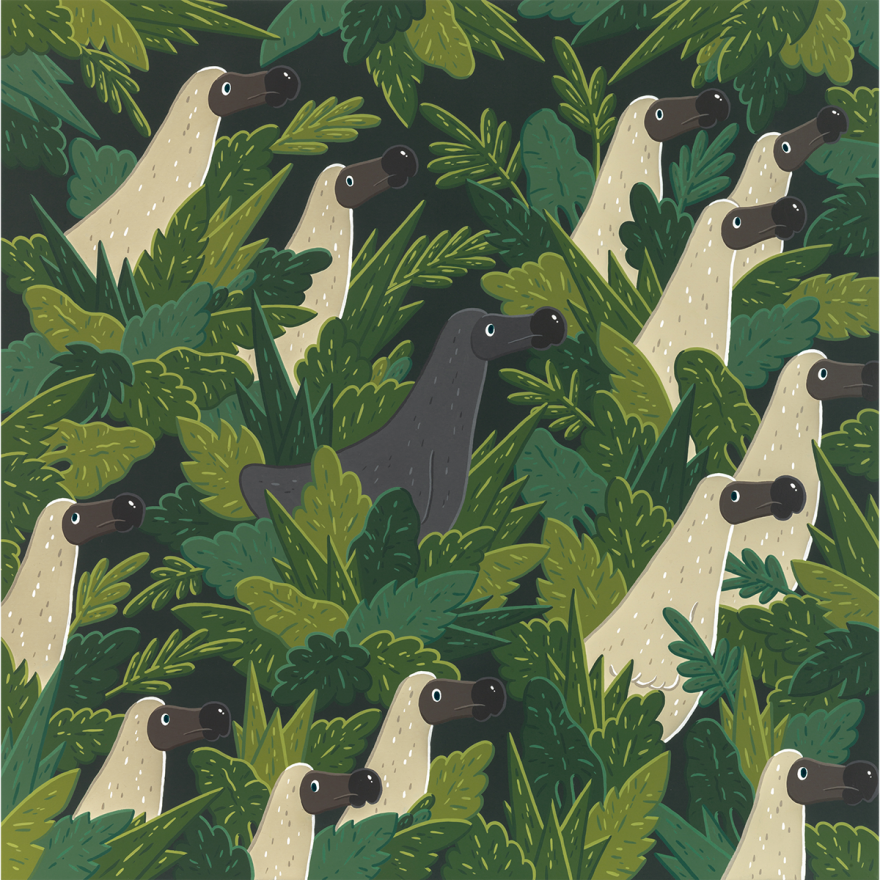
In most parts of the world, we are constantly being given these templates of ‘how to be’. Some of these are incredibly helpful to shape a healthy, happy, independent life. A lot of them are just expectations of others. It starts early with the never-ending extra-curriculars that parents sign-up their kids for. It continues on to expectations around what colleges you apply to, what internships you pick, what sector you work in, chasing promotions, getting a “passive income” and even when to buy your own home.
Borrowed ambitions chase us around by forcing us to do things we think we ought to do because someone expects us to do them. We mistake extrinsic expectations to be intrinsic ambition. They are goals without expiry dates that linger like the taste of heartburn.
The Financial Times just published my second letter to them (the first one was last Feb...have i started a pattern here?) It's about something I've been paying a lot of attention to as I study the interplay of societal shifts, technological upheveal and economic realities: how are ambitions of Gen Z being shaped? We've collectively decided to bake our youngest minds in a hyper-competitive, high-stakes oven without full clarity on how the outcomes will be shaped a decade from now. I wrote a response sharing how we seem to reinforce to students that there are only a few limited ways to live a successful life. Rutger Bregman calls consultancy, finance, and corporate law the "bermuda triangle of talent".
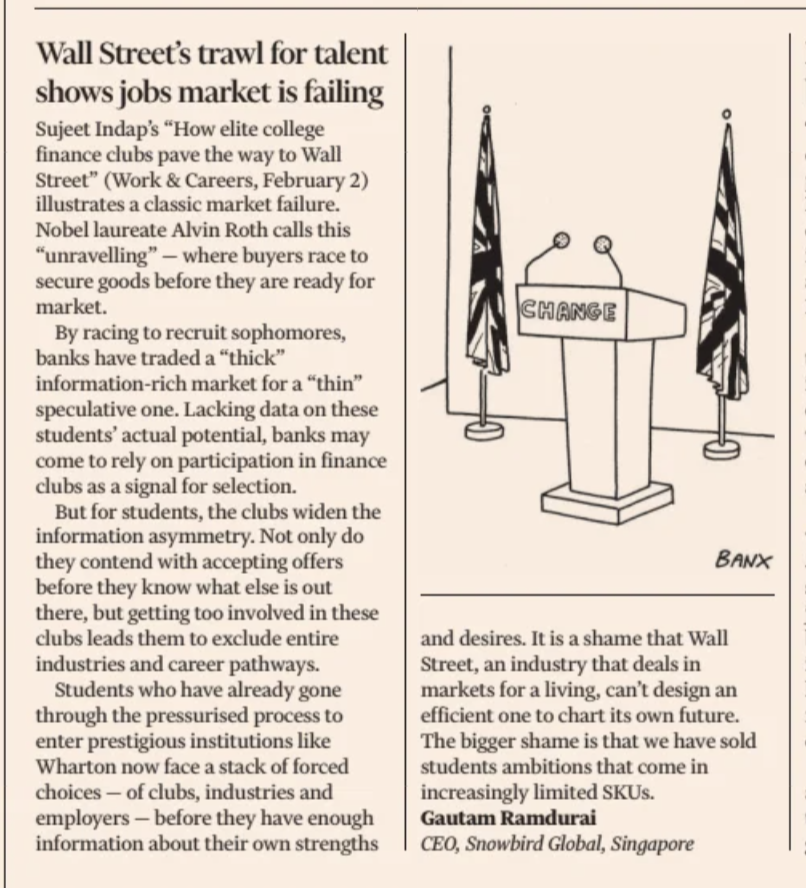
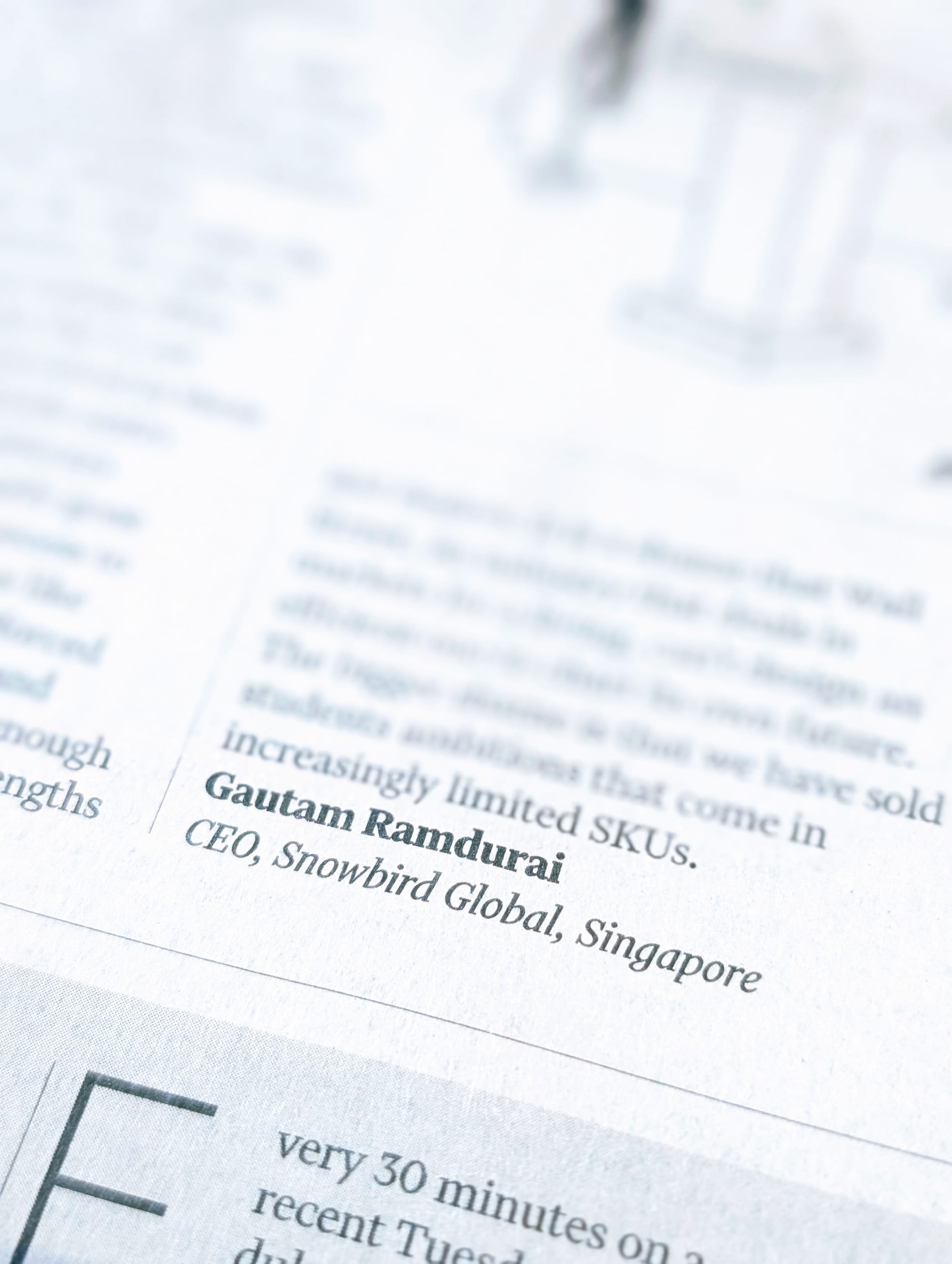
The Financial Times recently published a letter I sent to them about how we are corrupting the ambitions of the next generation.
THE SNUFFING OUT OF IMAGINATION
Kim’s dodos are creatures who have willingly traded their freedom for certainty. And certainty is valuable. Nearly half of Korean workers now juggle multiple income streams as daily expenses outpace earnings. They have the longest commutes in the world and a brutal work culture. The templates for life are handed to you when you’re just a toddler. To understand why young people in the West feel trapped, just look East to learn from those who have already gone through this.
In the West, much has been written about the “end of ambition”. The state of ambition today, like many things, traces back to the pandemic. There was a collective shift in our desires. And the work we were willing to put up towards those desires. Remember the great resignation? Or quiet quitting that followed soon after? These weren’t necessarily entirely new phenomena, but a reaction to the unmasking of warped systems that operated the world.
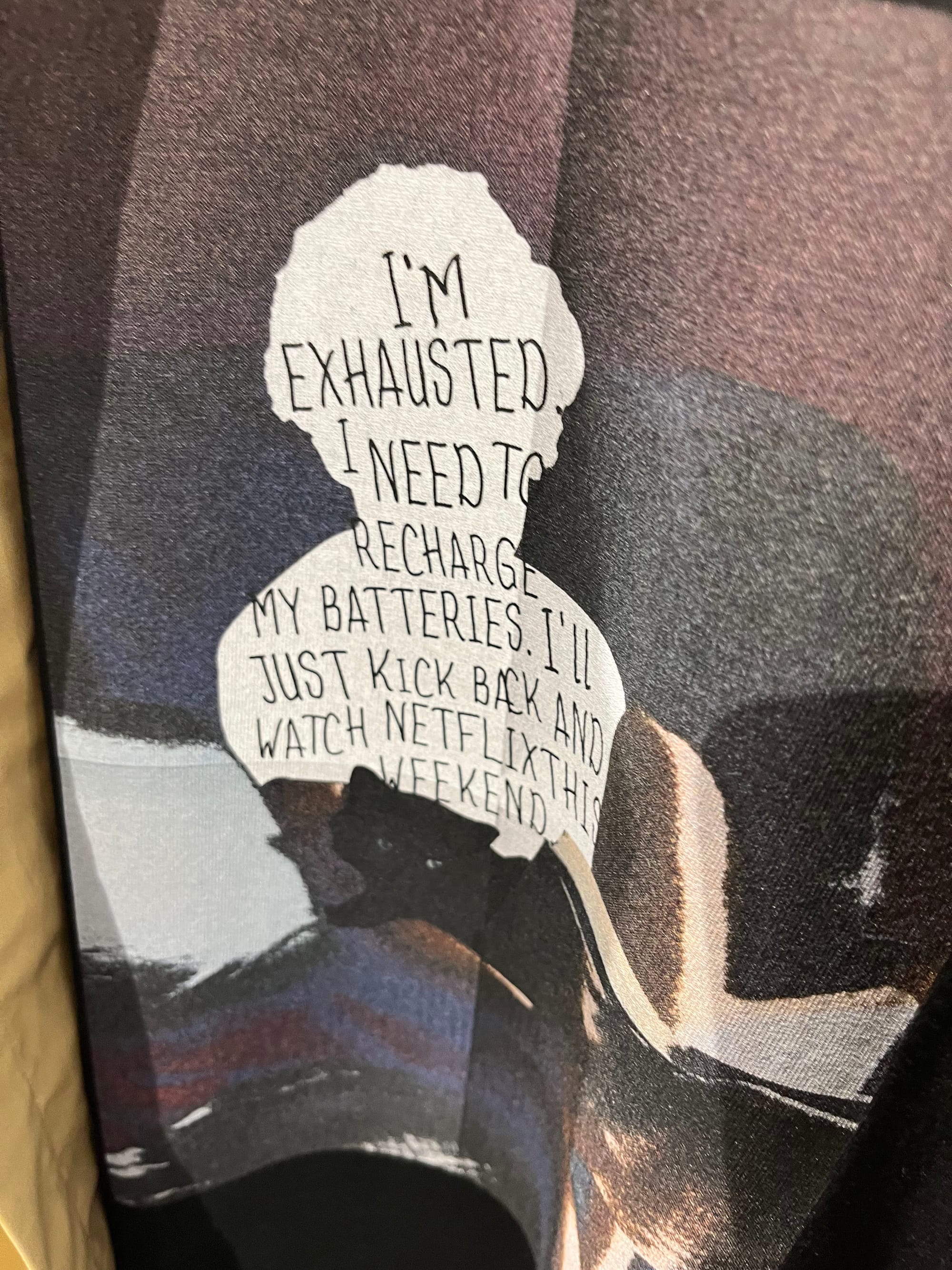
It’s a rough time for ambitions. The polycrisis we find ourselves in is overwhelming people and cutting them off from their ability to think of alternatives. It’s hard to be ambitious when it’s hard to just be. For The Guardian, Theresa McPail writes:
“ I have noticed that most of my friends have been struggling to think beyond the next few days or weeks. I, too, have been having difficulty conjuring up visions of a better future – either for myself or in general.”
Ambition used to be associated with the other vestige of the 2010s: success. Success, signaled by strata that are pre-defined. Strata that has been agreed upon by the status quo. But as social mobility grinds to a halt, where youth unemployment is about to hit record levels across the developed world, these strata will remain an illusion. A sort of hologram that we want the people to keep looping through until they decide to wake out of the stupor and opt-out. The guardian piece talks to a therapist who has seen a pattern emerge.
“The consensus is that people don’t seem to feel that good about their lives now. There’s a lot of despair. I have a few clients who don’t really have plans anymore. And when I ask my clients about what they’re looking forward to, most have no answer. They’re not looking forward to things.”

AMBITION POST-AI
What would it mean to not be grinding when the grind actually doesn’t result in the next level unlocking in the game of life. Infinite grind doesn’t inspire ambition. This is what techno-feudalism wants. It wants you to not want. Why play a game when you can stream others playing it? Why want when AI can do?
There is a well-written essay going viral about what a seismic moment this is - how AI will come for your job. In it Matt Shumer talks about how the latest AI models are ready to replace not just the “augmentation” work but also matters of taste and judgement. So you “don’t have to”.
Why want to do anything when it can do it for you? You making new things doesn’t fill Sam Altman’s coffers. It wants you to not want to make things. It wants you to just stir the infinite swirl of everything that already exists.
Someone in academia shared how tenure-track faculty and all their PhD students are going to use Claude Code to generate new papers to publish. To which an INSEAD professor responded with this:
“It's time to ask a basic question: are we training PhD's to a) get published or b) build useful knowledge? The correlation between these objectives was never perfect, but it may be set to decline rapidly, just as the need for humans to do either might also be declining. None of these variables need to go to zero for cataclysmic change to come to academia. Buckle up!"
A version of this story will play out in all fields. Are you a)getting students to be good at test-taking or b)preparing students with knowledge in fundamental subjects? Are you a)Getting clients all the design under a certain cost and under a certain hourly commitment or b)getting them the deliverable that has the highest potential to solve their core problem? Are you a)trying to maximize steps and measure every single calorie or b)build strength, avoid obesity. Yes, there is correlation between each of these pairs. But AI will always score better on the (a)s. We, as a society, have prioritized (a)s. But (b) is what we really want. If AI takes over (a), we still have to not give up on wanting (b) and know that they’re not the same.
The act of 'wanting' is now a rebellion. And what takes wanting what you want, not what someone else expects you to want, is downright revolutionary.
The worst blows - of COVID, of relentless expectations, of AI - are all being dealt to young people. We’re about to see (and already have in some markets like China) a massive spike in youth unemployment. And there are few things worse for the world than young people in despair.
A DIFFERENT POSSIBILITY
Young people around the world are opting out of this. From the rat people of China to the rise of contract work in Japan. In the UK, people would pick fitness over a promotion. Being able to define your own ambition is an absolute privilege. The Gen Z protests around the world should tell you that their ambitions for themselves and their nations are high. And they will fight to get their governments to deliver. These seem far away from talk of AI, but are deeply connected. They are all about systems that are stacked against the young but need them to be participants and/or consumers of it.
Increasingly opting-out means reaching for the nearest phone to record yourself. All is not well for those who think “content” is the opt-out where you monetize your own lived experience. They trade one form of penury for another. The ex-Private Equity guy who opts-out of the NYC rat race now joins a slightly different one as a content creator who is backpacking through China. You go from being crushed by the whims of a tyrant manager to crushing yourself under the weight of opaque algorithms. At least you’d be able to see when the manager was having a bad day. Even forms of existence that seem to eschew the traditional, the hierarchical are just part of the digital dystopia of you’re only as good as your last Insta reel. Even paths that seem to be independent were laid out by the invisible hand of the algorithm.
But eventually, at least when Gen Alpha grows up they’ll be on the other side of this disillusionment of systems of work and media. Even Kim Sun Woo retains hope in his landscape with dodos. There is still a chance to soar up again, showing the birds looking up at the sky or flying on balloons.

INSTINCT AND AVERSION
Despite templates that are copied by millions of others, ambition often feels solitary. You feel alone in your fight up the corporate ladder. You feel left behind if you don’t get into the elite finance club at your ivy league university.
What if ambition was about the interrelationship that you have with the world around you. This could be your own community. This could be your own family. This could be your friends or the place you live in. So redefining ambition around “i am” and not “i have”. And the “I am” is in the context of the world you embody. I would call this instinct. You find a vector inside you that directs you somewhere. This is true for people, and for companies.
I spoke to a CEO recently about their expansion plans. My advice to them was to not follow industry playbooks. If they do, every company would land at the same spot. Yes, absolutely look at consumer insights. Yes, definitely look at competitor activity. But when it comes to deciding what to do next, a good starting point is to look into your own soul. We love admiring those who forged a different path, but want the well-trodden ones when it comes to our own selves. Embracing our own messy selves and the messy worlds we embody hones our instinct.
Migratory birds undertake seasonal, long-distance journeys between breeding and wintering grounds, often traveling thousands of kilometers using the sun, stars, and Earth's magnetic field for navigation. When birds migrate thousands of miles they are following this instinct.
"There is something economist Jon Kay wrote in his book in 2024. I’ve been putting this quote in all my decks - in the last year it has become the core of what we do. Business is embedded in a social, political and cultural environment, and we cannot understand its outcomes without understanding these interrelationships." — John Kay, Economist, The Corporation of the 21st Century
That is my instinct. It is what I do even if no one is paying me to do it. To want to read, consume and learn as widely as possible and interrogate the interplay between them. Most companies pay their leaders and teams to go deep - deep into product, into their industry, and sometimes yes, deep on consumers too. But this depth leaves little or no room for any breadth.
Looking at how social/cultural shifts, geopolitics and tech interplay with each other is a game of keen observance and constant connection. Politics has toppled any predictability in markets, which in turn seems disconnected from how people live on a daily basis, and people are living lives immersed in and mediated buy tech that they have little control over, which then informs social consensus that will shape politics in the future.
In call it the three body problem of business. Amidst tracing and understanding the interplay between these, lies the answer to the question “what should we do next?” I’ve known in my instincts that the chaos theory of the multiverse is more practical than just being the domain of physics nerds. I’m obsessed with connections. I’m obsessed with how there are no clean causal loops in the real world. The three-body problem, in astronomy, is the problem of determining the motion of three celestial bodies moving under the influence of their mutual gravitation. No general solution of this problem is possible, as the motion of the bodies quickly becomes chaotic. To me, geopolitics, tech and culture are the three-body problem for business.
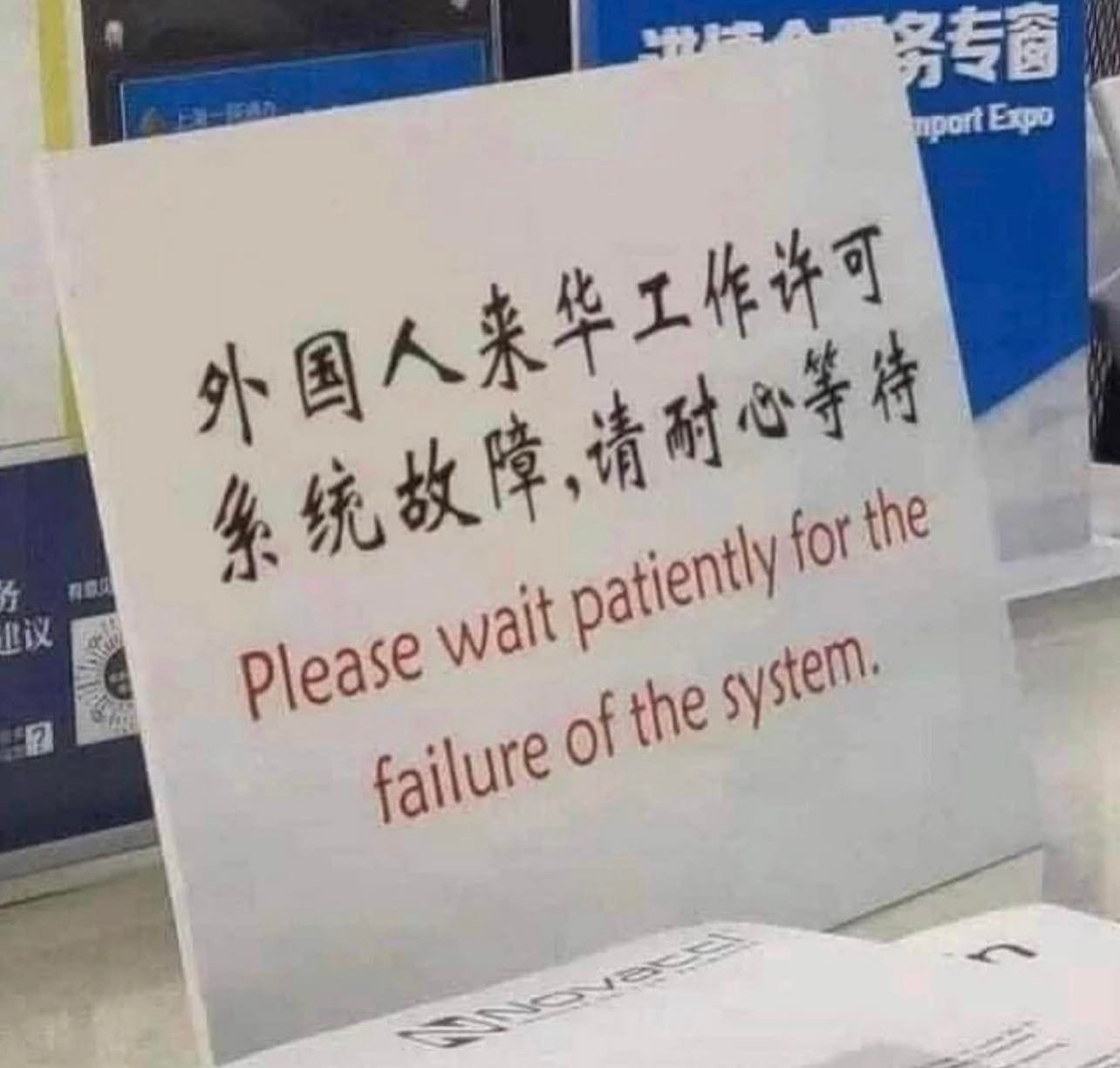
The world has unraveled in the past year. Trump, AI, The Epstein Files. It seems like there is so much happening in the world that we can hardly make sense of it all. And it’s coming from all directions. When we see systems crumbling around or failing us, maybe just instinct isn’t enough. We need to think in inversions. What are we actively rejecting? What do we have an aversion to? Whether you are a company or a person - what are you exhausted by?
I have no interest in shilling 'disruption'. I have no interest in 'scaling up'. I have no interest in exits. I have no interest in raising capital. I am exhausted by the world of work we have built ourselves. Where companies, their leaders, and their employees are stuck in a doom loop. Where every year’s planning cycle feels urgent yet remarkably like a broken record. It’s the McKinseyfication of entire industries. Where everything gets put in neat little buckets that wish away the complexity of what it means to run a real business solving real problems for real people in a really messy world. Companies, and their leaders, defeat themselves before their competitors even gets to it. Like Kim's dodos, they trade flight for certainty. But stagnation that feels like stability can, and will, vaporize.
After following my instinct and heeding my aversions, my ambition for snowbird is to serve as a wayfinder out of these doldrums.